More worth your time at the same venue, plus a few nearby picks.

SCULPTURE
Ideal and Form: 19th Century Sculpture from the Nationalgalerie Collection
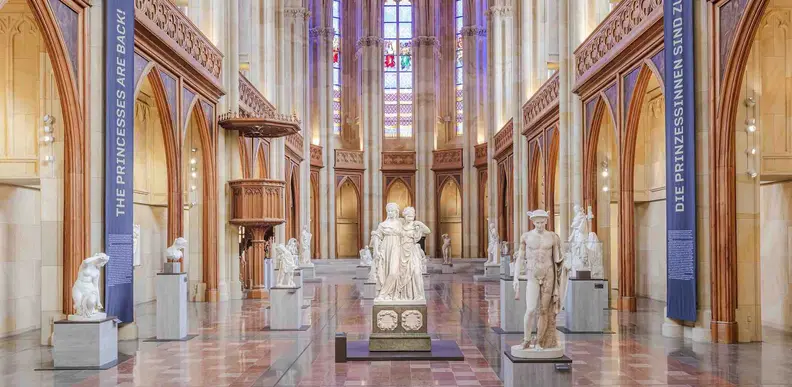
The Friedrichswerdersche Kirche (Friedrichswerder Church), planned and built by Karl Friedrich Schinkel from 1824‒30, has been a museum church and also a branch of the Alte Nationalgalerie since 1987.

EXHIBITIONS
The Princesses Are Back!. A New Exhibition of Schadow’s Princess Group in the Friedrichswerdersche Kirche
Johann Wolfgang von Goethe once adoringly described sisters the Luise and Friederike of Mecklenburg-Strelitz as “heavenly visions, whose impression upon me will never be effaced”.

EXHIBITIONS
Focus on Schinkel. A Look at His Life and Work
For the first time since the opening of the Friedrichswerdersche Kirche as a museum, the space will feature a new documentary display on the life and diverse artistic oeuvre of Karl Friedrich Schinkel.
FAMILY
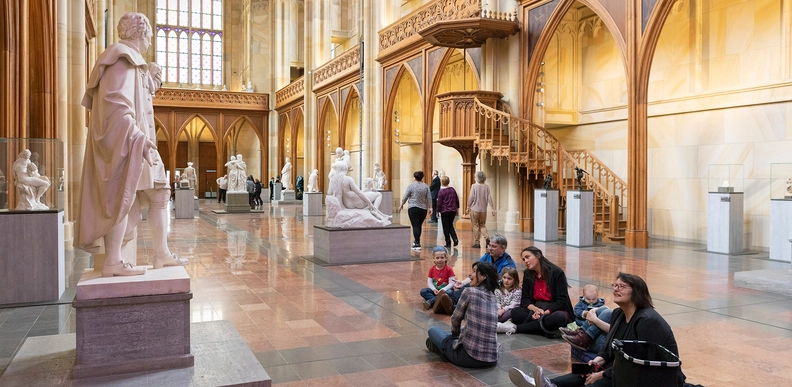
Prinzessinnen, Künstler und Co.
Why is a person carved in stone? Do you have to be dead for that? Why are they all naked? The stories of the sculptures in the Friedrichswerder Church are told in an exciting way for children and adults.

EXHIBITIONS
The Crown of Kerch. Treasures from the Dawn of European History
Gold jewellery from the migration period found near the Black Sea, silver brooches and magnificent belts from early medieval graves in France, Italy, Spain, and Germany: selections from the collection of Johannes von Diergardt will be on view again in Berlin for the first time…

CONTEMPORARY
Dioscuri – The Given Day
This special exhibition, presented in the staircase hall of the Neues Museum, offers a dialogue on the meaning of time, mortality and the connection between past and present.

EXHIBITIONS
Plain Talk. About the History of the Bode-Museum
For the very first time, the Bode-Museum itself is the focus of an exhibition. The Bode-Museum welcomes around a quarter of a million visitors every year, and its façade is one of Berlin’s most iconic images.

EXHIBITIONS
The Pazzi Conspiracy. Power, Violence and Art in Renaissance-Era Florence
On 26 April 1478, Lorenzo and Giuliano de’ Medici were attacked in the chancel of the Duomo of Florence. Giuliano was killed in the attack, while Lorenzo survived and went on to take revenge on the people responsible for masterminding the conspiracy – most notably the Pazzi…